Frequently asked questions.
How is your evaluation different from a public school’s evaluation?
Public school evaluations are free, but they must be requested through your child’s school and can sometimes be denied. When they are granted, the evaluation is focused on deciding whether your child meets eligibility criteria for special education services under federal education law. Schools do not provide diagnoses because they follow education code rather than the DSM-5-TR diagnostic criteria.
Eligibility vs. diagnosis: In schools, eligibility is typically determined by how much a challenge impacts academic performance. In many cases, a child must be performing well below grade level to qualify. As a private evaluator, I can assess and support your child before they reach that point.
Scope of recommendations: School reports generally focus on accommodations within the public school system. If your child attends a private/independent school or needs support at home, those recommendations may not be provided.
Depth of evaluation: My assessments are typically more comprehensive and holistic. I can address both DSM-5-TR diagnoses and federal education code criteria when needed. I also provide recommendations tailored for school and home settings, and connect families with outside services when appropriate.
In short, my evaluations give families a clearer, broader understanding of their child’s strengths and needs, along with practical next steps that go beyond the limits of the school system.
Do you perform neuropsychological evaluations?
While I am not a neuropsychologists, I have a Diplomate in School Neuropsychology Credential, awarded by the American Board of School Neuropsychology (ABSNP). This advanced training allows me to assess a wide range of psychological processes—such as attention, executive functioning, memory, visual-spatial skills, auditory/phonological skills, and communication abilities—at a level far more comprehensive than what is typically offered in a public school evaluation or by a Licensed Educational Psychologist without ABSNP training.
I tailor my testing to the specific questions families want answered about their child’s learning and abilities. While a full neuropsychological evaluation is especially valuable when a neurological disorder is suspected, my background in both psychology and education gives me a unique perspective. Because I understand how schools operate, my recommendations are often more practical, better received by teachers, and easier to implement in real classrooms.
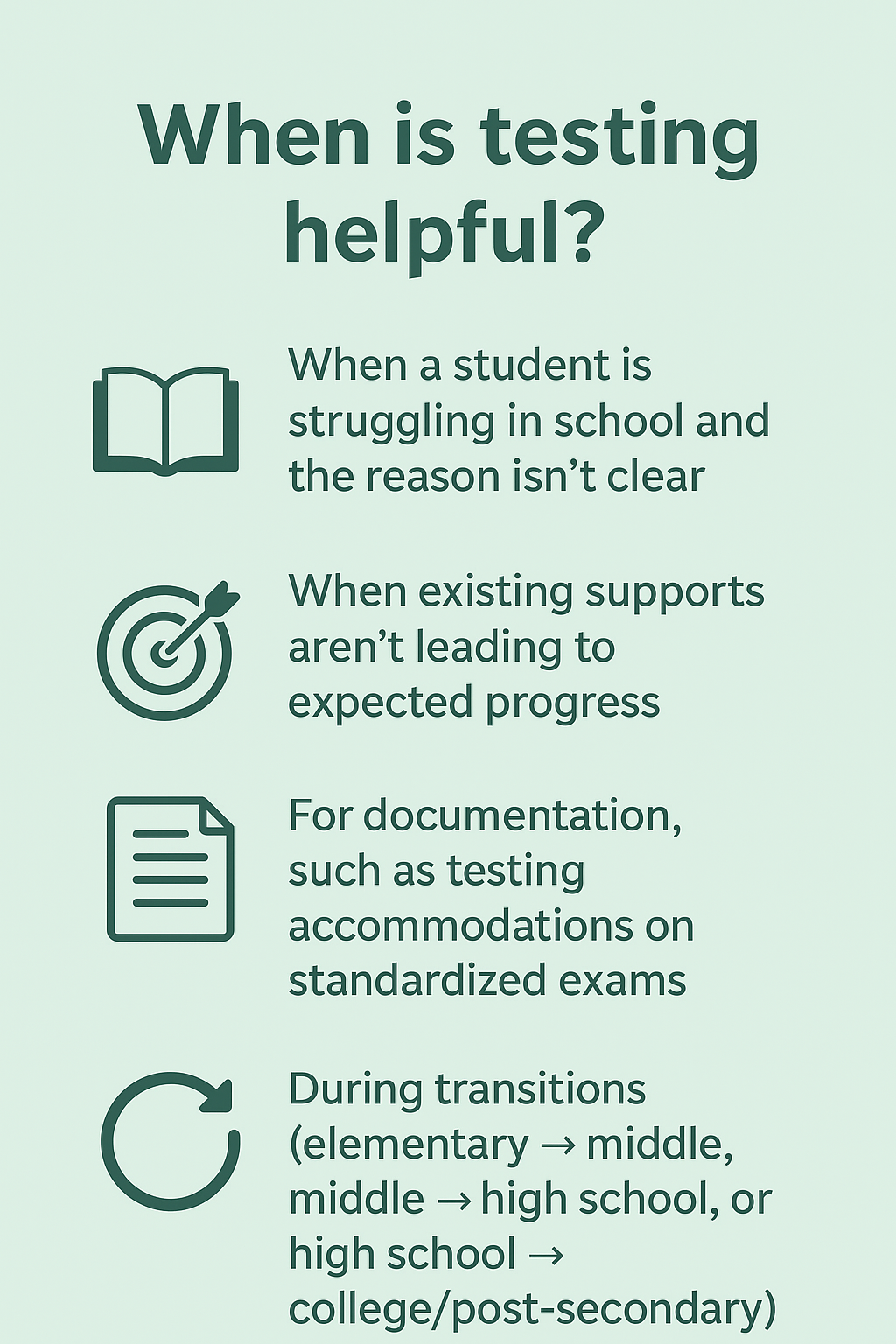
When is an evaluation appropriate?
When a student is struggling in school and the reasons for this are not clear
When existing supports aren’t leading to expected progress
For documentation, such as testing accommodations on standardized exams
During transitions (elementary → middle, middle → high school)
Can you just test my child for ADHD or Dyslexia only?
It may seem straightforward to test for just one issue, but in practice, this approach often raises more questions than answers. Conditions like ADHD and dyslexia don’t have a single “yes or no” test, and challenges with attention, learning, or processing rarely occur in isolation. In fact, it’s very common for multiple areas of difficulty to overlap.
A comprehensive evaluation helps us look at the full picture—not just one piece—so we can clarify what’s really going on and create recommendations that are tailored to your child’s unique needs. For example, attention difficulties can be caused by many different factors, so looking only at attention without exploring other areas may miss the true source of the problem. Just like a doctor wouldn’t examine only part of your body if you had a fever, I do not believe assessing just one area of learning or functioning in isolation is the best approach.
The only time a shortened evaluation IS appropriate, is when the child is being reevaluated for a diagnosis that is well established and there is no reason to suspect that it is incomplete, inaccurate or no longer applicable. I will consider an abbreviated evaluation on a case by case basis.
What to Expect During the Evaluation Process:
The intake is for parents/caregivers only and lasts about 1-2 hours. During this meeting, we will review your child’s history in detail, go over paperwork, and answer any questions you may have.
School Observation
Before testing begins, I will observe your child in their school setting to better understand how they learn and interact in the classroom. I schedule the school visit prior to my first meeting with your child so that they do not know that I am observing them.
Testing Appointments
The evaluation may include some or all of the following measures: cognitive/IQ testing, processing speed/efficiency, visual processing, visual-motor/fine motor skills, auditory processing, language processing, memory, attention, executive functioning, and academics (i.e., reading, writing, and math). I also do a thorough social/emotional assessment, which is then integrated with the cognitive results to provide a comprehensive understanding of the child as a whole person. Each test battery is custom-tailored to the individual so that I get sufficient information to understand the issues without wasting time and resources on unneeded measures. I like to consult with any providers working with the student as well, such as teachers, tutors, therapists, etc.
The number of testing sessions needed varies significantly depending on your child’s age, attention span, stamina and how many processing areas are being assessed. On testing days, you may wait for them or return when your child’s session is finished. I begin by explaining to your child why they are here and what to expect in simple, reassuring terms. Sessions include a variety of activities such as academic tasks, puzzles, memory games, listening exercises, and drawing tasks. I schedule plenty of breaks (including snack breaks), so please pack a water bottle and snack for your child. Many students say the experience is more engaging than they expected—and some even enjoy it!
Parent Feedback Meeting
About three weeks after the last testing session, parents return for a 1–2 hour feedback meeting. At this time, I review the results, share tailored recommendations for home and school, and provide referrals if needed. If appropriate, I also set up a separate child feedback session so the student can hear a positive, age-appropriate summary of their strengths and supports.
Final Report
Following the feedback meeting, parents receive a full written report (PDF) by email. This document meets or exceeds requirements for school accommodations and high-stakes testing (e.g., ISEE, SAT, ACT). Parents also receive any additional paperwork (such as a referral list). I am happy to send the report to outside providers upon request, though I strongly recommend parents remain the point of contact with schools to ensure full control over who receives their child’s information.
What Should I Tell My Child About the Evaluation?
Deciding to have your child evaluated is an important step—and sometimes children are part of that decision, too. Talking about it shows your child that there’s nothing to be embarrassed about, that you’re there to listen and support them, and that this is simply a way to better understand how they learn and what can help them succeed.
For Grade Schoolers
Begin with what’s fun at school, then gently ask what feels harder. For example: “What do you enjoy most at school? What’s the trickiest part?” Their answers don’t need to match the reason you’re seeking an evaluation—what matters is giving them a chance to share their perspective.
Help your child understand how the evaluation will be helpful. Both you and your child will gain valuable insights into why certain academic tasks feel challenging. More importantly, you'll receive practical strategies and tools to work through those difficulties together.
Describing the Process
It's crucial to explain what the evaluation actually involves. Make it clear that this isn't a traditional test with right or wrong answers. Instead, the evaluation consists of various activities designed to understand how your child learns best. Many of these activities are actually engaging and enjoyable.
Emphasize that there are no grades involved. Your child doesn't need to study beforehand, and it's impossible to "fail" the evaluation—even if they don't know some answers or struggle with certain activities. What matters most is their effort, because the evaluation helps everyone understand your child's unique learning style and thinking patterns.
Presenting the Plan
You might say something like: "I've found a wonderful specialist whose job is helping teachers understand the best ways to teach each student. You'll meet with Ms. Kim several times to do some activities that will help her figure out how you learn best."
For Middle and High School Students
Older students are typically more aware of their academic challenges and often understand why they're being evaluated, especially if you've maintained open conversations about their school experiences. They may also realize that the process could result in receiving special education services.
It's essential to address any concerns your child might have about potential outcomes. Consider discussing these key points and asking for their thoughts and questions.
Understanding the Support Team: Explain that a team—including you, teachers, and specialists—will receive information to better understand your child's school challenges and learning needs.
Potential Services and Support: The school may provide additional support and services to make learning more accessible. This could include specialized instruction methods, modifications to assignments, or accommodations such as extended time for tests.
Specialized Support Staff: Your child might work with additional teachers or specialists who have specific training in addressing particular types of learning challenges.
Addressing Social Concerns: Some students worry more about the social implications of being evaluated than the academic aspects. It's important to address any concerns about being "labeled" or treated differently by peers.
Setting the Right Tone
Remember that your goal is helping your child feel comfortable and confident about the evaluation process. Make sure they understand this isn't a punishment for academic struggles. Instead, frame it as the most effective way for you and their teachers to provide the right kind of support for their success.
The evaluation is ultimately about understanding your child's strengths and creating the best possible learning environment for them to thrive.
What are your rates and do you take insurance?
This will be determined after your free phone consultation. Generally, I provide flat fees and will inform you of any significant changes.
I don’t take insurance, but at your request, I can provide you with a "superbill" (a type of receipt with CPT codes you submit to your insurance for potential reimbursement). You may need to meet your deductible before your insurance will reimburse you.
Ask your insurance if they reimburse for the following CPT codes as provided by a Licensed Educational Psychologist based on these services: Psychological testing (90791, 96130, 96131, 96136, 96137).